

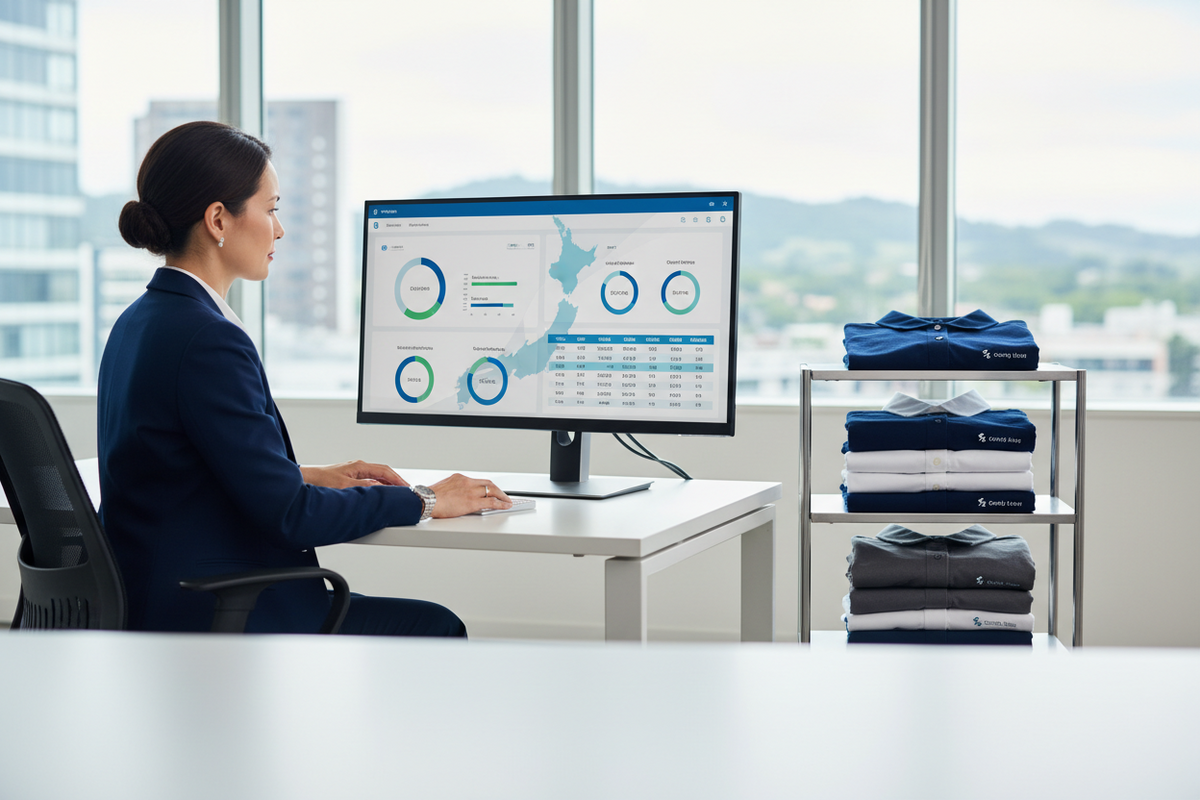
Symbion Health had more than 3,000 employees across Australia, New Zealand and Japan—and its uniform program required two full-time accountants to administer. Uniforms.com.au helped transform that labour-intensive process by implementing U:Portal, our purpose-built uniform management system.
The result was a controlled, employee-driven ordering system that managed approved garments, annual allocations, departments and country-specific requirements. It saved Symbion Health the cost of two full-time accounting roles while removing thousands of dollars and countless administration hours from its uniform-ordering process.
The real cost of uniform management is often hidden
Many large organisations focus on the price of each garment when assessing the cost of a uniform program. In our experience, that is only one part of the equation.
The administrative work behind the garments can become a much larger expense. Someone must confirm employee eligibility, check approved styles, monitor allowances, place orders, resolve errors and ensure employees from different departments receive the correct garments.
When these tasks are performed manually across thousands of employees, uniform management can become a substantial operational burden.
This was the challenge facing Symbion Health. Its uniform requirements were complex enough that two full-time accountants were responsible for uniform ordering and administration.
How did Uniforms.com.au begin working with Symbion Health?
Our relationship did not begin with the entire organisation. Uniforms.com.au initially won the opportunity to supply uniforms to one department of Symbion Health.
We concentrated on delivering that program properly. As Symbion Health gained confidence in our service and uniform-management capabilities, our involvement expanded until we were entrusted with the uniform requirements of the wider business.
That growth was significant. The program ultimately needed to support more than 3,000 employees operating across Australia, New Zealand and Japan.
Supplying garments at that scale was only part of the challenge. Symbion Health needed a reliable way to control who could order, what they could order, how much they could spend and which uniform range applied to them.
Why was the existing ordering process inefficient?
A manual uniform program creates a constant stream of small administrative tasks. Each task may appear manageable on its own, but the workload multiplies quickly across thousands of employees, multiple departments and three countries.
Without a controlled ordering platform, administrators may need to:
- confirm whether an employee is eligible to order;
- identify the correct departmental uniform range;
- check the employee’s remaining annual allocation;
- prevent unapproved garments from being ordered;
- account for different requirements between countries;
- place or approve individual orders; and
- respond to routine questions from employees.
Symbion Health was using skilled accounting resources to manage these processes. The business did not simply need a new uniform supplier—it needed a better operating system for its entire uniform program.
How did U:Portal automate the uniform program?
Uniforms.com.au supplied Symbion Health with U:Portal, our purpose-built uniform ordering and management platform. The system provided central control while allowing individual employees to place their own approved uniform orders.
Each employee’s ordering access was governed by three important parameters:
- Annual allocation: Each employee received a set yearly allowance for uniforms.
- Approved departmental range: Employees could only access garments authorised for their department.
- Country: The available range and ordering rules could be controlled according to whether the employee was based in Australia, New Zealand or Japan.
These controls allowed employees to manage their own uniform orders without giving them unrestricted access to the entire product range.
Instead of an accountant manually checking every request, the ordering rules were built into the system. Employees could select from their approved range and order within their allocated allowance, while Symbion Health retained control over the overall program.
What changed for Symbion Health?
The most important change was the removal of repetitive manual administration. Uniform ordering no longer needed to be managed through two full-time accounting positions.
U:Portal helped Symbion Health:
- allow eligible employees to place their own orders;
- apply annual uniform allocations consistently;
- limit employees to approved departmental garments;
- manage country-specific uniform requirements;
- reduce preventable ordering errors;
- remove unnecessary approval and data-handling steps; and
- maintain organisational control without manually processing every order.
By automating these rules, the system saved the cost of two full-time accounting roles as well as thousands of dollars and a considerable number of staff hours throughout the ordering process.
The value was not limited to wage savings. Automation also created a more consistent process for employees and reduced the organisation’s dependence on individual administrators to keep the program operating.
The biggest saving was created by better control
Automation is sometimes misunderstood as simply giving employees access to an online shop. For a large organisation, that is not enough.
An uncontrolled online store can create different problems, including unauthorised purchases, inconsistent garments and employees exceeding their allowances. Effective uniform automation needs clearly defined rules behind the ordering experience.
For Symbion Health, the strength of U:Portal was its ability to combine employee self-service with strict organisational controls. Employees gained a simpler ordering process, while the business maintained authority over ranges, allocations, departments and countries.
That balance is what allowed the administration work to be removed rather than merely transferred to another team.
What can other organisations learn from this case study?
After more than 27 years in the uniform industry, I have seen many organisations underestimate the internal cost of managing uniforms. The invoice from the uniform supplier is visible. The hours spent administering the program are often spread across accounting, human resources, procurement, operations and individual department managers.
For a large or geographically dispersed workforce, the right question is not simply, “What does each uniform cost?” A more useful set of questions is:
- How many staff hours are spent processing uniform orders?
- Who checks employee eligibility and remaining allowances?
- How are different departmental ranges controlled?
- How often are incorrect or unapproved orders submitted?
- Can employees order for themselves without weakening purchasing controls?
- What happens when the organisation expands into another location or country?
If the answers reveal a heavily manual process, the organisation may be spending considerably more on uniform administration than it realises.
When does a uniform management portal make sense?
A managed ordering portal is most valuable when an organisation has a large workforce, multiple locations, several departments or defined employee allowances. It can also be useful when different roles require different garments or when uniform rules vary between business units and countries.
Smaller businesses with a limited range and only occasional orders may not require the same level of automation. In those circumstances, a simpler bulk-ordering process may be more practical.
The purpose of a portal should not be to introduce unnecessary technology. It should remove administration, improve control and make uniform ordering easier for both employees and management.
Uniform supply should solve an operational problem
The Symbion Health project demonstrated that a uniform supplier can deliver value far beyond garments. By understanding how uniforms were being ordered, approved and administered, Uniforms.com.au was able to address the larger operational cost behind the program.
What began with one department developed into an organisation-wide uniform solution supporting more than 3,000 employees across three countries.
U:Portal gave employees the ability to order their own approved uniforms while allowing Symbion Health to retain strict control over annual allocations, departmental ranges and country requirements. Most importantly, it removed the need for two full-time accountants to manage the process manually.
If your organisation is spending too many hours administering uniforms, Uniforms.com.au can review the current process and help determine whether a managed ordering portal is commercially appropriate.
About the author: Jason Ham founded Uniforms.com.au in 1999 and writes from practical experience supplying uniforms, workwear and branded apparel to Australian organisations.
Share:
How to Choose Work Uniforms in Australia: A Practical Business Guide
The Story Behind Ricky Ponting and Adam Gilchrist’s Custom Test Cricket Blazers